
Tip Credit Notice: No Warning Means Full Minimum Wage
Tip Credit Notice: No Warning Means Full Minimum Wage
Your check says $2.13 an hour. Nobody ever explained why. No manager sat you down at hire, no one handed you anything to read, and the number simply appeared on your first paycheck. That silence is not a small oversight. Under federal law it can be worth more than every tip you have been shorted.
This post answers one question: what happens when your employer never told you it was taking a tip credit?
The $2.13 wage is a discount your employer has to earn
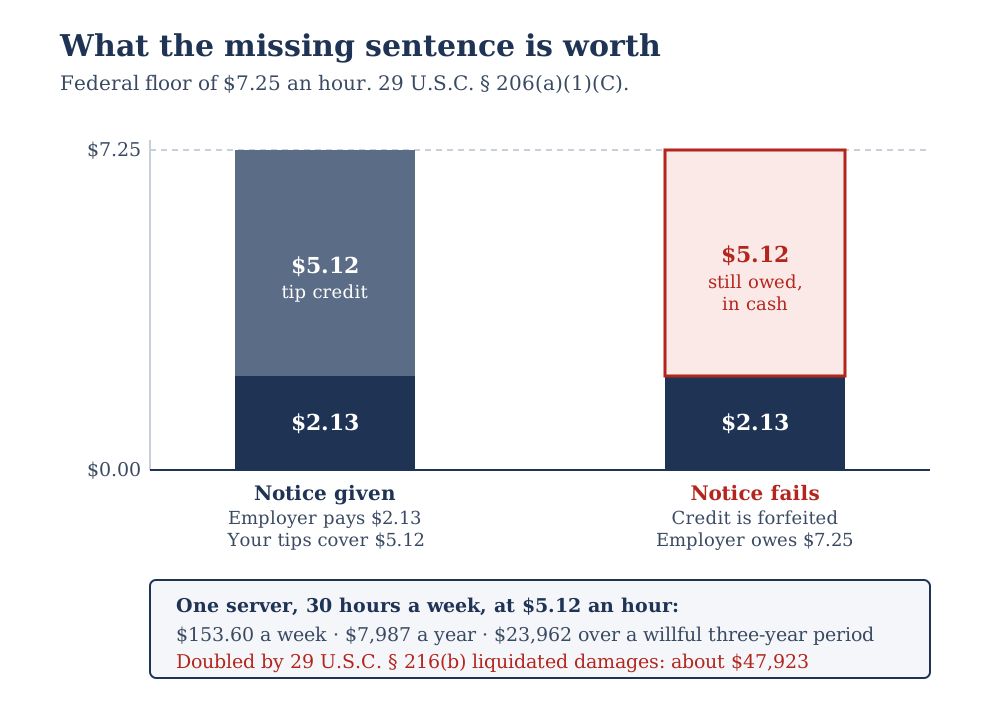
The federal minimum wage is $7.25 an hour. 29 U.S.C. § 206(a)(1)(C). The Fair Labor Standards Act lets a restaurant pay a server a lower cash wage and count her tips toward the rest. That is the tip credit. 29 U.S.C. § 203(m)(2)(A). Department of Labor regulations put the cash floor at $2.13 an hour, 29 C.F.R. § 531.50(a), which leaves $5.12 an hour that the employer covers with your tips instead of its own money.
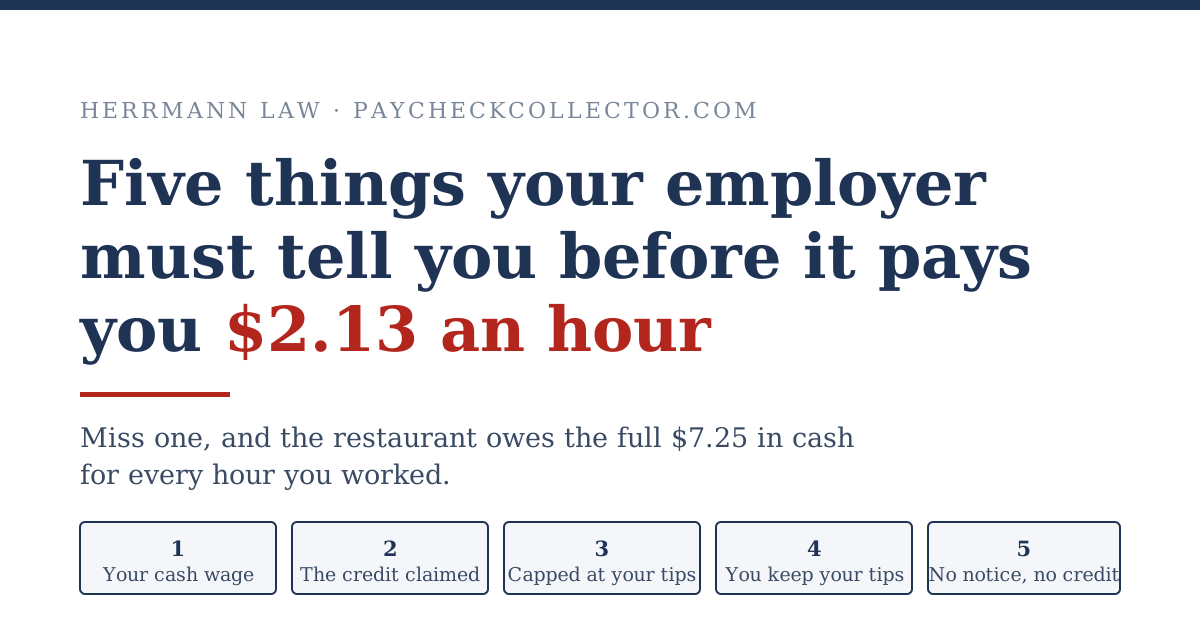
The discount comes with a condition written into the statute itself. The tip credit formula “shall not apply with respect to any tipped employee unless such employee has been informed by the employer of the provisions of this subsection, and all tips received by such employee have been retained by the employee.” 29 U.S.C. § 203(m)(2)(A). An employer that misses either condition loses the discount — it owes the full $7.25 in cash for every hour you worked.
Your employer must tell you five things, and telling you four is not enough
The Fifth Circuit spelled out the list in a case our firm brought and won, Ettorre v. Russos Westheimer, Inc., No. 21-20344 (5th Cir. Mar. 18, 2022). An employer must inform its tipped employees of its use of the tip credit, including:
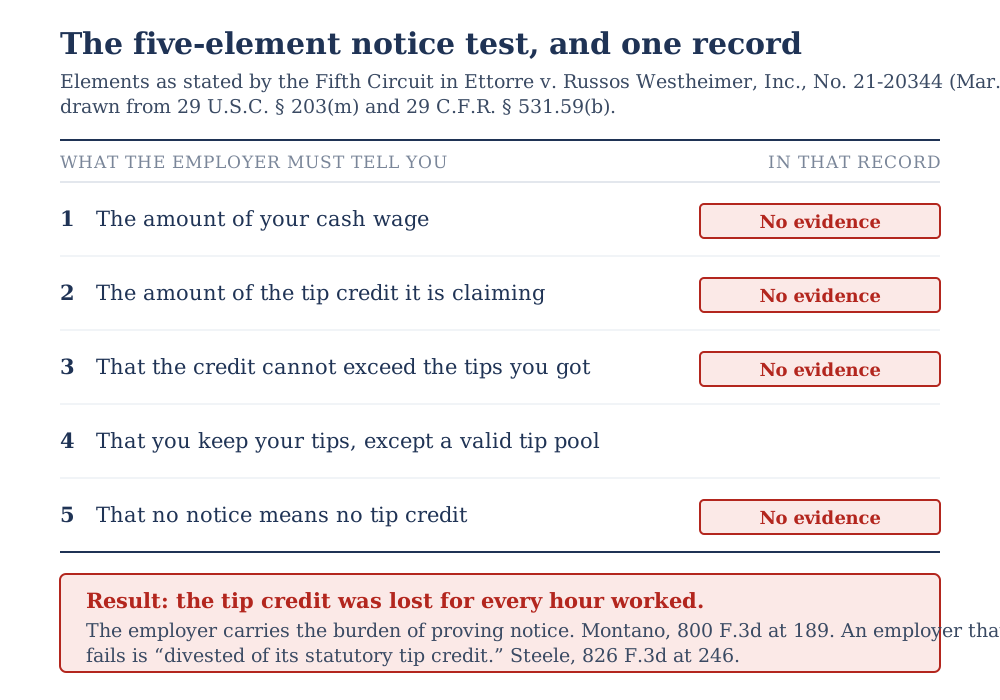
- the amount of the employee’s cash wage;
- the amount of the tip credit the employer is claiming;
- that the amount claimed may not exceed the value of the tips actually received;
- that all tips must be retained by the employee, except for a tip pool limited to employees who customarily and regularly receive tips; and
- that the tip credit does not apply to any employee who has not been informed of all of these requirements.
The court drew that list from 29 U.S.C. § 203(m) and 29 C.F.R. § 531.59(b). It also said how the telling has to happen, agreeing “with the many courts that have recognized that an employer must affirmatively inform its tipped employees of the tip credit components.”
That word “affirmatively” carries the whole rule. Notice is something the employer does. It is not something you are supposed to figure out.
Knowing what you were paid is not the same as being told
Russo’s defended the case by arguing its server already knew. It pointed to her deposition, where she said she was paid $2.13 an hour. The Fifth Circuit was unimpressed:
“At best, the questioning shows that Ettorre knows how much she was paid. It does not suggest Ettorre was told by her employer that she would be paid $2.13 per hour. Nor does it suggest that Ettorre knew she would be paid $2.13 before she was actually paid that amount.”
Reading your own paystub is not notice. Neither is doing the math after the fact. The server had been told one thing, that she could keep her tips, and the district court found no evidence on the rest of the list.
A handbook nobody handed you is not notice either
Russo’s also claimed an employee handbook did the job. The court walked through what was actually in the record: “there is only evidence that there were copies of the handbook in the restaurant. There is no evidence that Russos gave a copy of the handbook to Ettorre.” Then the sentence that matters most for anyone whose employer is about to make the same argument: “there is absolutely no evidence showing what was in the employee handbook.”
A binder in the manager’s office is not notice. A handbook you signed for is only notice if someone can show what it said about the tip credit.
Your employer has to prove it told you, and you do not have to prove it didn’t
This is the part most servers get backward. Under federal law, “[t]he employer bears the burden to prove it is entitled to the tip credit.” Montano v. Montrose Restaurant Associates, Inc., 800 F.3d 186, 189 (5th Cir. 2015). If the employer cannot carry that burden, it “must be divested of its statutory tip credit for the relevant time period.” Steele v. Leasing Enterprises, Ltd., 826 F.3d 237, 246 (5th Cir. 2016).
In Russo’s, the restaurant’s own corporate representative did not know whether the company had told the server anything, and admitted she did not think there was a company policy of telling employees about their wages when they were hired. That answer is what a missing practice looks like once it is written down in a transcript.
The math: one missing sentence is worth $5.12 an hour
Take a server who works 30 hours a week at $2.13. If the tip credit fails, the employer owes $7.25 in cash for every one of those hours, and the difference is $5.12.
- $5.12 × 30 hours = $153.60 a week
- × 52 weeks = $7,987 a year
- Two years of unpaid wages = $15,974
- Three years, if the violation was willful (29 U.S.C. § 255(a)) = $23,962
Then the statute doubles it. Section 216(b) makes an employer liable for the unpaid wages “and in an additional equal amount as liquidated damages,” which turns that three-year figure into roughly $47,923 for one server. That is one server. A restaurant that never gave the notice to anyone did not give it to the whole shift, which is why these cases are usually brought as collective actions rather than one at a time. The employer pays the attorney’s fees too. The Fifth Circuit affirmed the fee award in Russo’s, quoting the rule that “an employer who violates the statute is also required to pay attorney’s fees.” Black v. SettlePou, P.C., 732 F.3d 492, 502 (5th Cir. 2013).
“We didn’t know” is not a defense to the doubling
Liquidated damages are the norm, not the exception. An employer avoids them only by proving it acted in good faith and on reasonable grounds, 29 U.S.C. § 260, and it carries a “substantial burden” to do it. Steele, 826 F.3d at 247. The district court in Russo’s gave the restaurant extra time to brief exactly that question. Instead of addressing good faith, the restaurant re-argued the merits it had already lost. The doubling was affirmed.
The deductions stacked on top can fail for the same reason
Russo’s took $10 out of every biweekly check and called it a “linen fee” for laundering aprons. The regulation answers that in one line: “[t]he cost of uniforms and their laundering is primarily for the benefit of the employer,” 29 C.F.R. § 531.3(d)(2)(iii), so it is not a cost the employer may count as part of your wages.
The restaurant argued the fee also covered fountain drinks and meals. It kept no records of what those cost, though 29 C.F.R. § 516.27(a) puts that recordkeeping duty on the employer. The only proof it offered was its own menu, and the court noted the obvious problem: menu prices include profit, so they say nothing about actual cost. Because the possibly lawful part of the fee could not be separated from the unlawful part, the entire fee came back. Brennan v. Veterans Cleaning Service, Inc., 482 F.2d 1362, 1370 (5th Cir. 1973).
What to do if no one ever explained your wage
Write down what you were told when you were hired, who said it, and when. Save your paystubs and any tip-out sheets or nightly closeout reports you can get. Note whether anyone ever handed you a handbook, and whether you ever saw anything in writing about the tip credit. If your restaurant runs a tip pool, pay attention to who is in it, because which coworkers may legally share your tips is a separate requirement that fails just as often. It is also worth reading how tip credit violations happen in the first place and what a tip credit case can recover.
Deadlines matter here. The FLSA reaches back two years from the day a lawsuit is filed, and three years if the violation was willful. 29 U.S.C. § 255(a). Every week that passes drops a week off the far end.
About Herrmann Law
We represent restaurant workers nationwide in unpaid wage, overtime, and tip theft cases, including the Houston server whose case is described above and the servers in the $21.2 million judgment against Perry’s Steakhouse. Every case turns on its own facts and records, and past results do not predict any particular outcome. Questions about your situation? Contact us by submitting your information on our website or by calling or texting our office at 817-479-9229.
This post is general information, not legal advice, and reading it creates no attorney-client relationship.
What to do if something feels off
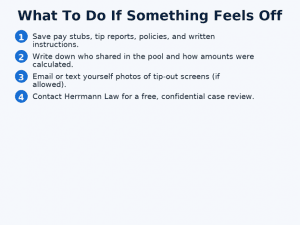
- Keep any Records you can. Keep copies of your pay stubs, POS reports, tip-out reports/breakdowns, employee policies/handbook, and any other documents your employer has given you or made available to you.
- Act quickly. Unlawful pools can mean recovering misdirected tips and back wages (often doubled), plus attorneys’ fees.
- Seek Legal Advice. Contact Herrmann Law to speak with an attorney for advice and guidance unique to your specific situation. We have represented thousands of restaurant workers across the United States. We offer free consultations and contingency fee agreements.
About Herrmann Law: We represent restaurant workers nationwide in unpaid wage, overtime, and tip theft cases. Questions about your situation? Contact us by submitting your information on our website or by calling or texting our office at 817-479-9229
You can also learn more by visiting our Legal Center for Restaurant Workers.
 Learn more about tipping laws and your rights
- Illegal Tip Pooling (Guide)
- Tip Pooling vs Tip Credit: What’s the Difference?
- Understanding Tip Credit Abuse
- Side Work Laws for Restaurant Employees
- Legal Center for Restaurant Workers
- Contact Herrmann Law
Disclaimer: The information on our website is provided for general informational purposes only, and is not legal advice. Laws, including wage-and-hour laws, vary by state and change over time. The facts specific to your situation and the laws in your state may lead to different outcomes. Do not act on this information without consulting a licensed attorney. For guidance on your specific situation, consult an attorney. No attorney-client relationship is created with Herrmann Law, PLLC and none of our attorneys represent you until Herrmann Law, PLLC has executed a written agreement, agreeing to represent you.