
Drive Time to Your First Job: Is It Paid?
Drive Time to Your First Job: Is It Paid?
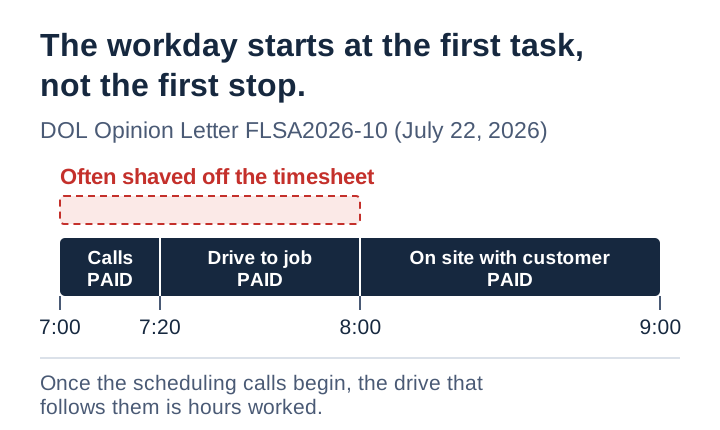
You make three calls from your kitchen table at 7 a.m., line up the day’s stops, then drive forty minutes to the first one. Your timesheet starts when you pull into the customer’s lot at 8. On July 22, 2026, the Department of Labor told a worker with that exact morning that his clock had already started, and that the drive was paid time.
The question this post answers
When your job starts at your own house, at what moment does your employer have to start paying you?
Your commute is unpaid, but it ends earlier than you think
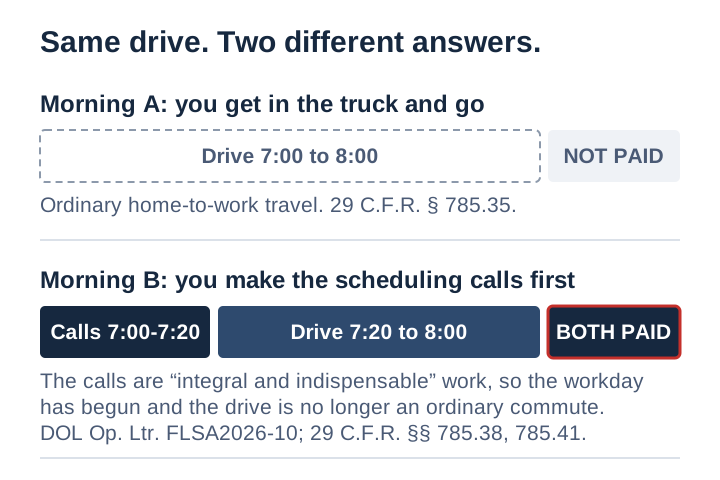
Congress wrote the general rule into the Portal-to-Portal Act, 29 U.S.C. § 254(a): an employer does not have to pay for travel to and from the place where the employee performs the principal activity of the job. The regulation says the same thing in plainer words. An employee “who travels from home before his regular workday and returns to his home at the end of the workday is engaged in ordinary home to work travel which is a normal incident of employment.” 29 C.F.R. § 785.35.
That rule covers the commute. It does not cover the workday.
Two other regulations mark where the commute ends. “Time spent by an employee in travel as part of his principal activity, such as travel from job site to job site during the workday, must be counted as hours worked.” 29 C.F.R. § 785.38. And “[a]ny work which an employee is required to perform while traveling must, of course, be counted as hours worked.” 29 C.F.R. § 785.41.
Every real case turns on where the morning falls against that line.
The DOL just answered this for a worker who makes calls before he drives
Opinion Letter FLSA2026-10, issued July 22, 2026, involved a field service engineer who installs and services MRI systems. He has no fixed office. Between 7 and 8 a.m. he receives three to five pages, calls clients for five to ten minutes each to schedule and arrange appointments, then drives an employer-provided vehicle to his first appointment. His paid shift runs 8 to 5.
The Wage and Hour Division split his morning into three parts and reached three different answers.
Receiving the pages is not paid. The Division called it a minor consequence of driving an employer-provided vehicle and treated it as incidental to commuting under 29 U.S.C. § 254(a).
The calls are paid. Time spent “calling clients to schedule and arrange the details of appointments, including scheduling other field service engineers, constitutes compensable hours worked” because those calls are “integral and indispensable to your principal activity.”
The drive after the calls is paid too. Because the workday had already begun, the Division concluded that the travel “is not, in fact, an ‘ordinary’ commute.”
The principle is short — once you perform a task that is integral and indispensable to your job, your workday has started, and the miles you drive after that are on the clock.
Not everything you do at home starts the clock
The Division issued a companion letter the same day, and it cuts the other way. FLSA2026-9 addressed an employee who works at both home and an office and drives between them mid-day as a voluntary alternative to an unpaid commute. That travel is still an ordinary commute. The Division was explicit that “work activities performed at home do not necessarily turn work-to-home or home-to-work travel into compensable worksite-to-worksite travel.”
Glancing at a schedule, reading a text, or checking email over breakfast is unlikely to turn your drive into paid time. The test is whether the task is integral and indispensable to the job you are paid to do. Making the calls that build the day’s route is. Receiving a page telling you the route exists is not.
Two other situations in the same regulations come up constantly and have nothing to do with morning calls. Travel is paid when a worker who has finished the day is called back out at night to travel a substantial distance for an emergency job, 29 C.F.R. § 785.36, and when the employer sends the worker on a special one-day assignment in another city, 29 C.F.R. § 785.37. The morning-call pattern is one way an employer ends up owing travel pay. It is not the only way.
One unpaid hour a day is not a rounding error
Take a technician paid $24 an hour and scheduled 8 to 5. He makes his calls from 7:00 to 7:20 and drives from 7:20 to 8:00. That is one unpaid hour a day.
Five days a week is five hours. His scheduled shift already fills forty hours, so every one of those five hours is overtime, owed at $36. That is $180 a week. (Our guide to how federal overtime pay is calculated walks through the mechanics.)
Over a fifty-week year, it is $9,000.
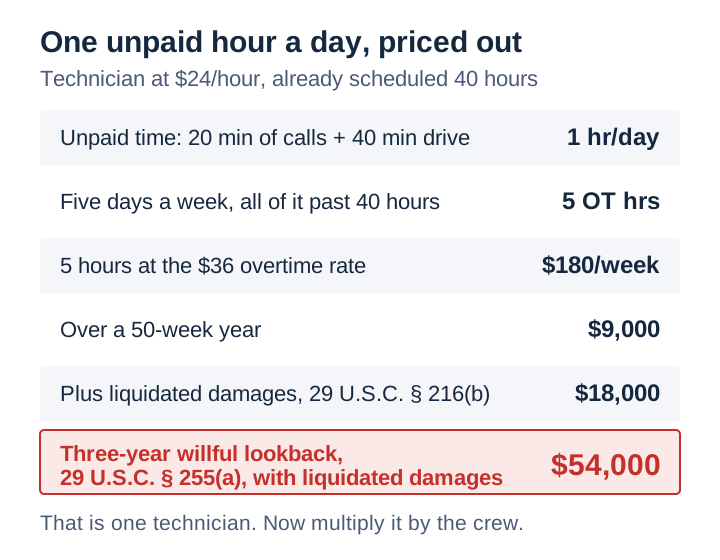
The FLSA does not stop at the unpaid wages. Section 216(b) entitles a worker to the unpaid overtime compensation “and an additional equal amount as liquidated damages,” which takes the figure to $18,000, and it requires the court to award “a reasonable attorney’s fee to be paid by the defendant, and costs of the action.” The lookback runs two years, or three years for a willful violation, under 29 U.S.C. § 255(a). At three years, that same technician is looking at $27,000 in unpaid overtime and $54,000 with liquidated damages.
Then multiply it by a crew of forty technicians who all start their mornings the same way.
The same morning repeats across field work
The pattern is not limited to MRI engineers. The same structure shows up in HVAC and appliance repair, cable and internet installation, pest control, home health and hospice, medical equipment service, security patrol, and courier and delivery work. The details change and the shape does not: the employer moves the first real task of the day to the worker’s house, then starts the clock at the first customer.
The signs are ordinary. Dispatch calls or texts you before your shift. You plan or confirm your route from home. You load, stock, or inspect the truck before you leave. A supervisor requires a check-in call before you roll. An app requires you to accept the day’s assignments by a set hour.
None of those facts decides a case by itself. Each one is a reason to look hard at when your paid time actually began.
What you can do about it
Write down the time of your first work task each day, not the time you reached the first stop. One line a day on your phone is enough.
Save the timestamps you already have. Pages, texts, dispatch app notifications, and call logs all carry a time and a date, and they are usually harder to dispute than a timesheet your employer controls.
Note whether those tasks are required or optional, because both DOL letters turned on that difference.
Note whether you signed anything about using a company vehicle. Section 254(a) treats employer-vehicle commuting within the normal commuting area as unpaid only where there is “an agreement on the part of the employer and the employee.”
Know that the deadlines are real. Under § 255(a) the clock runs backward from the day a claim is filed, so every week of waiting is a week that falls off the far end.
About Herrmann Law
We represent workers nationwide in unpaid wage and overtime cases, including technicians, installers, and drivers who go unpaid for the work they do before they reach the first stop. Questions about your situation? Contact us by submitting your information on our website or by calling or texting our office at 817-479-9229.
Related reading: cases we are currently handling · more wage and hour guides
Disclaimer: The information on our website is provided for general informational purposes only, and is not legal advice. Laws, including wage-and-hour laws, vary by state and change over time. The facts specific to your situation and the laws in your state may lead to different outcomes. Do not act on this information without consulting a licensed attorney. For guidance on your specific situation, consult an attorney. No attorney-client relationship is created with Herrmann Law, PLLC and none of our attorneys represent you until Herrmann Law, PLLC has executed a written agreement, agreeing to represent you.