
Salaried Overtime Rules 2026: It’s Still $684 a Week
Salaried Overtime Rules 2026: It’s Still $684 a Week
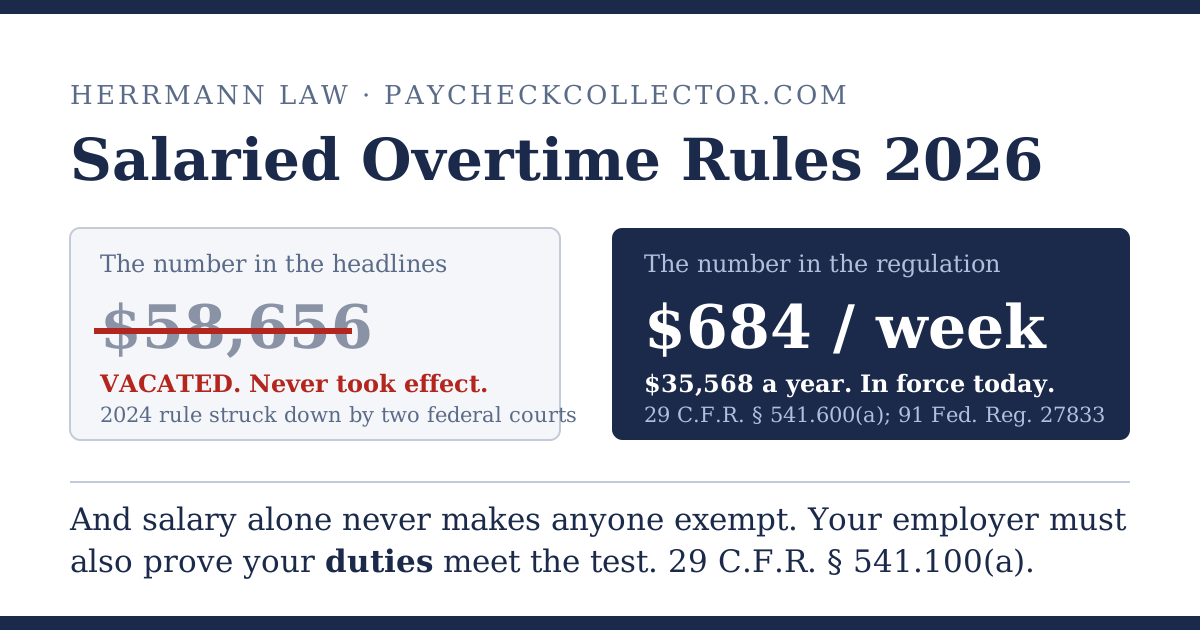
For two years, the headlines told salaried workers the overtime cutoff was going up to $58,656. It never happened. Two federal courts struck that rule down, and on May 15, 2026, the Department of Labor wrote the old number back into the regulation. The federal salary threshold is $684 a week, unchanged since 2020. And that number is the least important part of most overtime cases—determining whether an employee is actually exempt from overtime.
The question this post answers: your employer pays you a salary and calls you a manager. What does your employer have to prove before it can classify you as exempt and refuse to pay you overtime?
The threshold is $684 a week, and the $58,656 figure never became law
The Department of Labor’s 2024 rule would have raised the salary level in stages, topping out at $58,656 a year. By the Department’s own account, two federal courts in Texas struck the rule down, on November 15 and December 30, 2024. The Department’s technical amendment, published at 91 Fed. Reg. 27833 on May 15, 2026 and effective that day, “removes from the Code of Federal Regulations the regulatory language from a 2024 rule that was judicially vacated, and republishes the operative regulations, which were established in a rule the department issued in 2019.”
So the regulation reads as it did before the headlines. Under 29 C.F.R. § 541.600(a), an exempt executive, administrative, or professional employee must be paid on a salary basis at “not less than $684 per week.” The Department puts that at $35,568 a year. Highly compensated employees are covered separately: at $107,432 in total annual compensation, the employer gets a lighter duties test, but it must still pay the worker “at least $684 per week paid on a salary or fee basis.” 29 C.F.R. § 541.601.
Earn less than $684 in a week, and no white-collar exemption applies to you that week.
A salary alone never makes you exempt from overtime
Paying you a salary alone does not make you exempt from overtime. It makes you eligible to be exempt, nothing more. The rest turns on what you actually do.
The exemption comes from 29 U.S.C. § 213(a)(1), which covers “any employee employed in a bona fide executive, administrative, or professional capacity,” but only “as such terms are defined and delimited” by the Department’s regulations. Those regulations kill the employers’ favorite shortcut: “A job title alone is insufficient to establish the exempt status of an employee.” 29 C.F.R. § 541.2.
Your badge can say manager. The law does not care. Take the executive exemption, the one restaurants, retailers, most employers often lean on the hardest. Under 29 C.F.R. § 541.100(a), your employer must prove all four of these—otherwise your employer owes you back wages for overtime pay:
- You are paid on a salary basis at not less than $684 per week.
- Your “primary duty is management of the enterprise in which the employee is employed or of a customarily recognized department or subdivision thereof.”
- You “customarily and regularly direct the work of two or more other employees.”
- You have authority to hire or fire, or your “suggestions and recommendations as to the hiring, firing, advancement, promotion or any other change of status of other employees are given particular weight.”
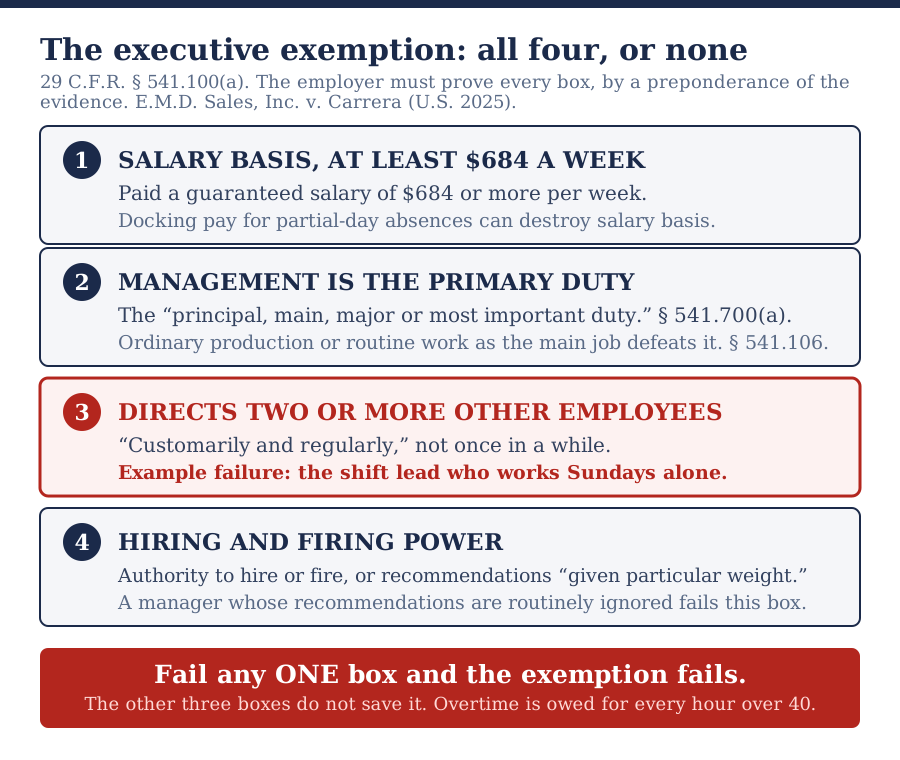
Each is a separate requirement. If your employer fails to prove a single one, then your are owed overtime— however good the other three look. The administrative and professional exemptions work the same way: every box, or no exemption.
And the burden is on the employer, period. In E.M.D. Sales, Inc. v. Carrera, decided January 15, 2025, a unanimous Supreme Court said plainly that “the law places the burden on the employer to show that an exemption applies.” You do not have to prove you deserve overtime. Your employer has to prove you are exempt and thus not entitled to overtime.
What you actually do decides it, not what the schedule calls you
“Primary duty” has a legal definition, and it is not a stopwatch. It means “the principal, main, major or most important duty that the employee performs.” 29 C.F.R. § 541.700(a). Courts weigh how important the management work is, how much time you spend on it, how closely you are supervised, and how your salary stacks up against the wages of the people you supposedly manage.
Spending more than half your time on management generally satisfies the test, but the regulation says “time alone, however, is not the sole test.”
The regulations talk about assistant managers by name. Under 29 C.F.R. § 541.106, working the line and managing in the same shift is not automatically disqualifying: an assistant manager “may perform work such as serving customers, cooking food, stocking shelves and cleaning the establishment” and keep the exemption, if management is still the main job. But the same rule draws a hard line: “An employee whose primary duty is ordinary production work or routine, recurrent or repetitive tasks cannot qualify for exemption as an executive.” The difference is control. An exempt assistant manager decides when to jump on the register and stays in charge while ringing. A misclassified one is told where to stand, on someone else’s schedule.
That is one way to fail, not the only way. A shift lead who runs the store alone on Sundays fails the third requirement, because there are never two other employees to direct. A “manager” whose firing recommendations get ignored fails the fourth. A salaried employee docked half a day’s pay for leaving early can lose the salary basis entirely.
The math on one misclassified assistant manager runs past $50,000
Say you are an assistant manager paid $48,000 a year, working 55 hours a week. That is $923.08 a week, well above $684. Under 29 C.F.R. § 778.113(a), your regular rate comes from “dividing the salary by the number of hours which the salary is intended to compensate.” If the salary was meant to cover 40 hours, your regular rate is $23.08 an hour.
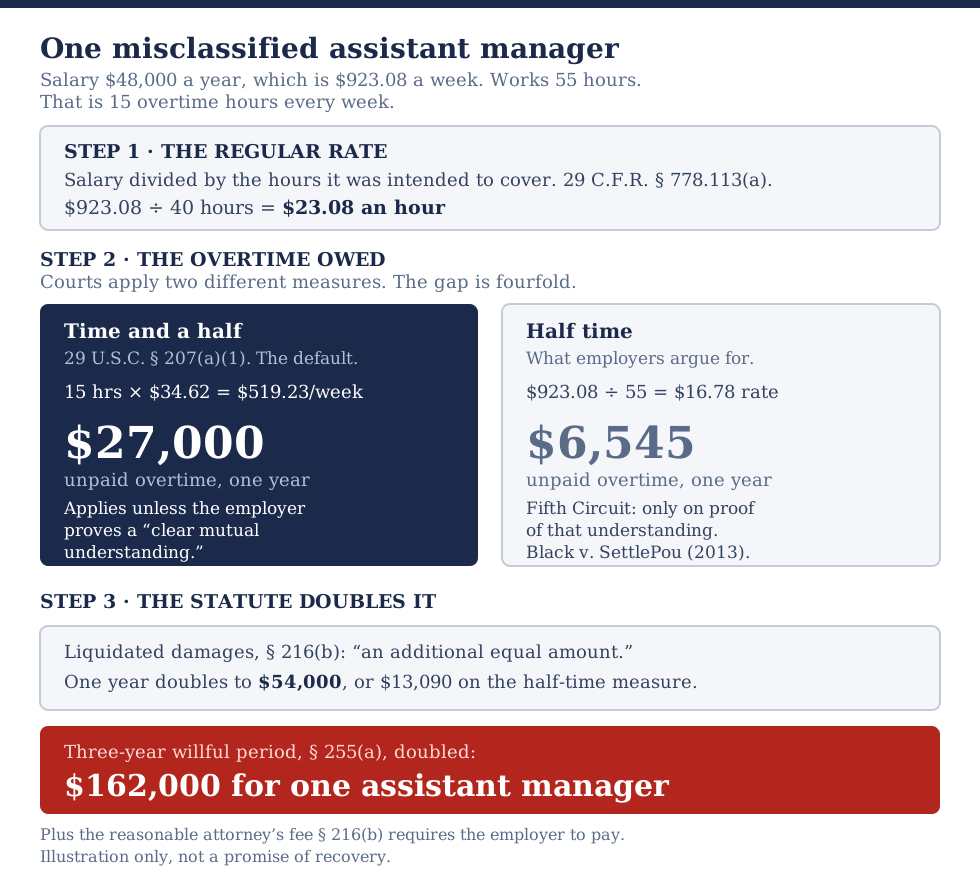
The FLSA requires “not less than one and one-half times the regular rate” for every hour past 40. 29 U.S.C. § 207(a)(1). Fifteen overtime hours at $34.62 come to $519.23 a week. That is $27,000 a year in unpaid overtime.
Then the statute doubles it. Under 29 U.S.C. § 216(b), an employer who violates the overtime rules owes the unpaid overtime “and in an additional equal amount as liquidated damages.” Now the year is worth $54,000. The look-back period is two years, or three if the violation was willful, under 29 U.S.C. § 255(a), so a three-year willful case for one assistant manager reaches roughly $162,000, plus the attorney’s fee § 216(b) makes the employer pay.
One caution, because the honest answer matters more than the biggest number. Employers argue that a misclassified salaried worker gets only a half-time premium, on the theory that the salary already covered straight time for every hour. Measured that way, the same worker recovers about $6,545 a year, not $27,000. Courts have divided on when that measure applies. In the Fifth Circuit, half-time applies only where the employer proves a “clear mutual understanding” that the fixed salary was pay for fluctuating hours; without that proof, the full time-and-a-half measure applies. Black v. SettlePou, P.C., No. 12-10972 (5th Cir. Oct. 11, 2013). That fight can change a case’s value fourfold, so treat any number you read online, ours included, as an illustration rather than a promise.
Your state may set a salary floor far above the federal one
The FLSA sets a floor, not a ceiling. No provision of the Act “shall excuse noncompliance with any Federal or State law or municipal ordinance establishing a minimum wage higher” than the federal minimum, “or a maximum work week lower.” 29 U.S.C. § 218(a).
Colorado is the clearest example. Under Colorado 2026 PAY CALC Order, 7 CCR 1103-14, the salary threshold for the executive, administrative, and professional exemptions is $1,111.23 a week, about $57,784 a year, effective February 1, 2026. Our $48,000 assistant manager clears the federal threshold and fails Colorado’s outright. In Colorado, the duties fight never starts.
Other states set their own numbers. The federal $684 is the floor everywhere; your state may demand more.
What you can do it about it
Start with your hours, the fact employers dispute most and document least. Write down your start time, end time, and unpaid breaks for every shift, even roughly. Keep screenshots of schedules, punch-app records, and every text telling you to come in early or stay late.
Then write down what you actually did: hours on the register, on the line, stocking, cleaning. How many people worked your shift. Whether anyone was ever hired or fired because you said so. That is the evidence that decides the duties test.
Contact Herrmann Law: Questions about your situation? Contact us by submitting your information on our website or by calling or texting our office at 817-479-9229.
This post is general information about the law and not legal advice, and reading it does not create an attorney-client relationship.
About Herrmann Law
We represent workers nationwide in unpaid overtime, minimum wage, and misclassification cases, and we do not represent employers. If your title says manager and your shift says otherwise, contact us by submitting your information on our website or by calling or texting our office at 817-479-9229.
Related reading: cases we are currently handling · more wage and hour guides
Disclaimer: The information on our website is provided for general informational purposes only, and is not legal advice. Laws, including wage-and-hour laws, vary by state and change over time. The facts specific to your situation and the laws in your state may lead to different outcomes. Do not act on this information without consulting a licensed attorney. For guidance on your specific situation, consult an attorney. No attorney-client relationship is created with Herrmann Law, PLLC and none of our attorneys represent you until Herrmann Law, PLLC has executed a written agreement, agreeing to represent you.