
Colorado Overtime Kicks In After 12 Hours in a Day
Colorado Overtime Kicks In After 12 Hours in a Day
You worked a fourteen-hour double on Friday. Open to close, one shift meal standing up. When the paycheck came, every hour was straight time, and the manager’s explanation sounded almost reasonable: “you only worked 38 hours this week, overtime starts at 40.” Under federal law, that is true. In Colorado, it is wrong, and it has been wrong for every double you have ever worked.
This post answers one question: when does an hourly worker in Colorado earn overtime?
Colorado has three overtime triggers, and the best one for you wins
The federal overtime rules have a single trigger: time and a half for hours over 40 in a workweek. 29 U.S.C. § 207(a)(1). Work a 16-hour day in a 38-hour week and federal law owes you nothing extra.
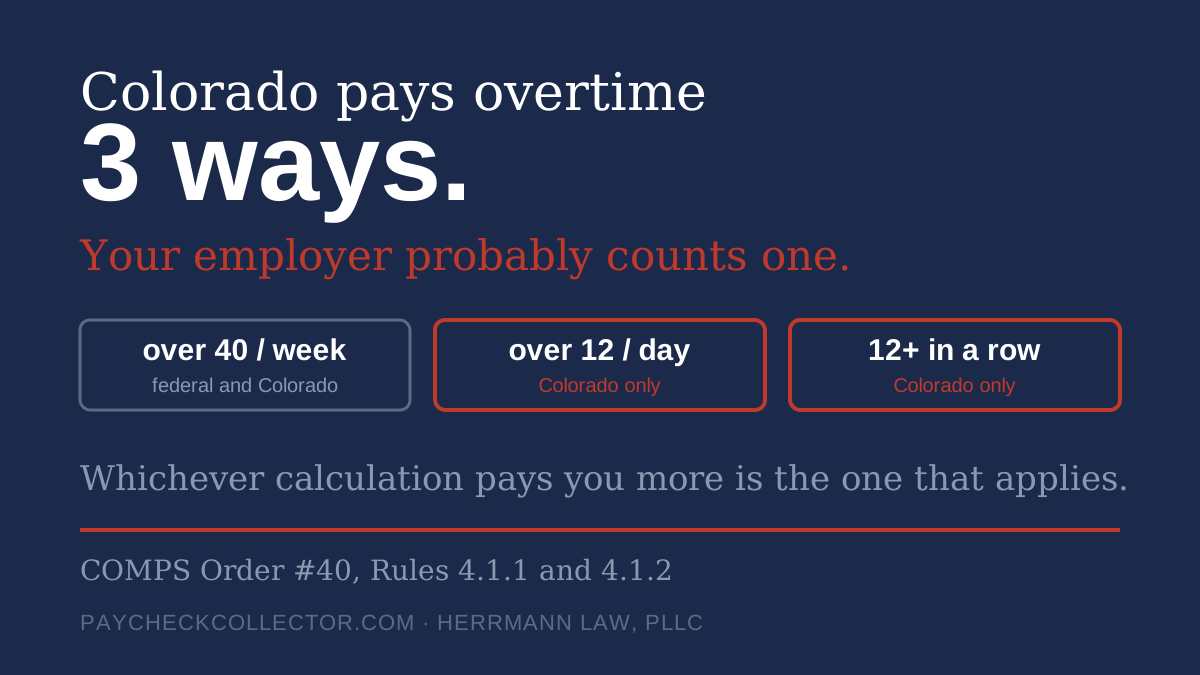
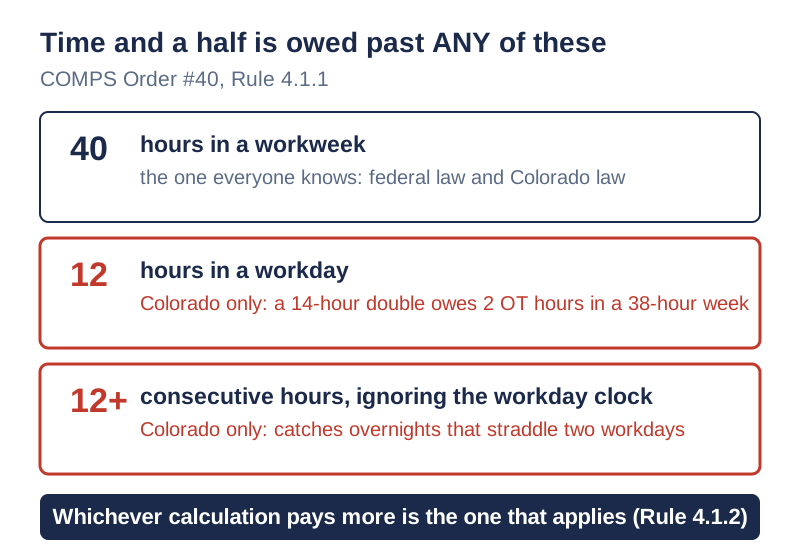 Colorado’s COMPS Order provides three separate triggers for overtime pay. Employees “shall be paid time and one-half of the regular rate of pay for any work in excess of” 40 hours in a workweek, 12 hours in a workday, or 12 consecutive hours without regard to where the workday starts and ends. COMPS Order #40, Rule 4.1.1. And the order settles any conflict in your favor: “Whichever of the three calculations in Rule 4.1.1 results in the greater payment of wages shall apply.” Rule 4.1.2.
That third trigger deserves a second look, because it catches shifts the daily rule misses. The 12-consecutive-hours calculation ignores the workday clock entirely. An overnight worker who starts at 6 p.m. and clocks out at 8 a.m. worked 14 consecutive hours, and the last two are overtime even if the shift straddles two calendar workdays that each stayed under 12. At $20 an hour, that is $20 more per overnight than a federal-only system will ever compute.
The double shift: overtime federal law never sees
Run the Friday double honestly. Fourteen hours at $20 an hour. Under Rule 4.1.1, hours one through twelve are regular time and hours thirteen and fourteen are overtime at $30. That is $20 extra for the day, and if you pull two of those doubles a week, $40 a week, roughly $2,000 over a fifty-week year, in a week that never touched 40 hours. Federal law sees the same week and owes zero.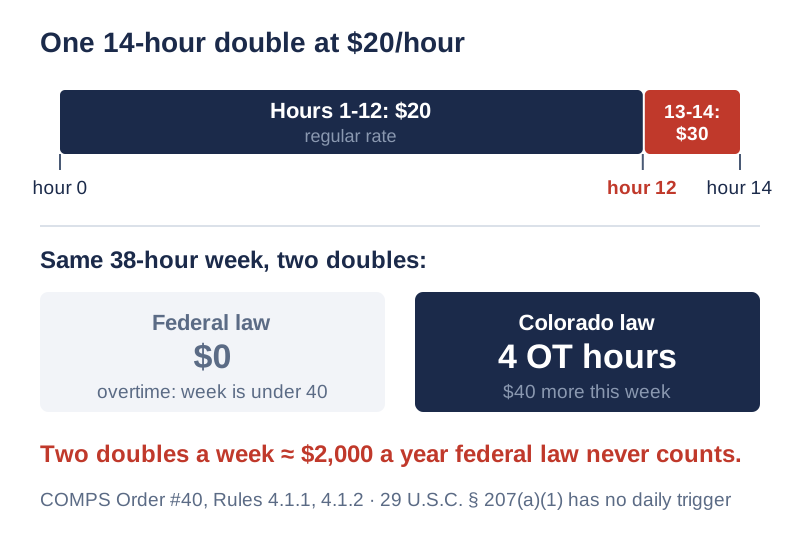
Now notice who works this pattern: restaurant doubles, hospital and care-facility shifts, hotel turnarounds, oil and gas hitches, wildfire and seasonal crews, warehouse peak days. Employers running national payroll systems configured for the federal 40-hour rule miss Colorado daily overtime by default, week after week, for entire workforces at once. That is what makes this a collective problem and not a bookkeeping one.
Counting it yourself takes one pass through a week. Take a schedule of 10, 14, 6, and 8 hours across four days: 38 total. The weekly trigger pays nothing, because 38 is under 40. The daily trigger pays 2 overtime hours, for the two hours past 12 on the 14-hour day. Rule 4.1.2 says run every calculation and pay the biggest one, so this week the daily calculation controls and two hours move to time and a half. Do that same pass over your last few months of schedules and you will know, before any lawyer does, whether your paycheck has been counting doubles or ignoring them.
Breaks are money too: 10 minutes paid every 4 hours, or it is unpaid wages
Colorado also mandates breaks that federal law does not require, and violating Colorado law carries consequences.
Every shift over 5 consecutive hours must include “an uninterrupted and duty-free meal period of at least a 30-minute duration,” and if the work makes relief impossible, you eat on duty and are “fully compensated for the on-duty meal period without any loss of time or compensation.” COMPS Order #40, Rule 5.1.
Every 4 hours of work earns “a compensated 10-minute rest period.” Rule 5.2. And here is the part almost no Colorado worker knows: a missed rest break is not just a bad shift. Under Rule 5.2.4, an employer’s failure to authorize and permit the break “is a failure to pay 10 minutes of wages” at your rate. Two missed breaks a day at $20 an hour is $6.67 a day, about $33 a week, more than $1,600 a year, sitting in your employer’s pocket in ten-minute pieces.
The meal rule interacts with the overtime rules too. If payroll automatically deducts a 30-minute lunch you actually worked through, that half hour is unpaid working time twice over: it is wages you earned, and it can be the half hour that pushes a long day past the 12-hour line. A worker whose “13.5-hour” double was really 14 hours has a daily-overtime claim the auto-deduction was quietly erasing.
Salaried does not automatically mean exempt from any of this
These rules cover hourly employees and misclassified salaried ones alike. Colorado’s exemptions require both a $57,784 salary in 2026 and strict duties tests, and Colorado’s exemption tests fail far more “managers” than employers admit. If your salary is under that number, the three overtime triggers above apply to you too, including the daily one, and a salaried manager working open-to-close doubles may have daily overtime claims no one has ever counted.
What you can do it about it
Write down your actual in-and-out times for every shift, especially doubles and overnights. The daily and consecutive-hours triggers live or die on those timestamps, and your own contemporaneous notes beat a timekeeping system configured to forget them.
Count your breaks for one week. Every shift over five hours without a duty-free thirty, and every four-hour block without a paid ten, is a line item with a dollar value.
Keep pay stubs and schedules, and talk to a wage-and-hour lawyer before raising it with management. Recovery periods are limited, and a pattern that runs back years is worth far more than the next paycheck.
One last thing: these patterns are almost never individual. A payroll system that ignores daily overtime for you ignores it for every coworker on the same system, every double, every overnight. That is why claims like these are often brought for whole crews at once, and why the first worker to count carefully matters.
Contact Herrmann Law: Questions about your situation? Contact us by submitting your information on our website or by calling or texting our office at 817-479-9229.
Colorado’s tipped wage floors · Colorado Wage Theft · Colorado Paid Leave Required for Workers in Colorado
This article is general information, not legal advice, and reading it does not create an attorney-client relationship.
About Herrmann Law
We represent workers nationwide in unpaid overtime, minimum wage, and misclassification cases, and we do not represent employers. We represent hourly and misclassified salaried workers nationwide, including in Colorado, in unpaid overtime and wage cases. If you work in Colorado and have questions, contact us by submitting your information on our website or by calling or texting our office at 817-479-9229. Consultations are free, and we handle these cases on contingency: you pay nothing unless we recover for you.
Cases we are currently handling
Disclaimer: The information on our website is provided for general informational purposes only, and is not legal advice. Laws, including wage-and-hour laws, vary by state and change over time. The facts specific to your situation and the laws in your state may lead to different outcomes. Do not act on this information without consulting a licensed attorney. For guidance on your specific situation, consult an attorney. No attorney-client relationship is created with Herrmann Law, PLLC and none of our attorneys represent you until Herrmann Law, PLLC has executed a written agreement, agreeing to represent you.