
Tip Pooling Before Open: Who Legally Shares Your Tips?
Tip Pooling Before Open: Who Legally Shares Your Tips?
Every shift, your restaurant takes a cut of your sales out of your tips. Call it a tip share, a tip-out, or a pool: money you earned at your tables goes to other people on the clock. Some of those people clocked in at 6 a.m., hours before the doors unlocked, and left before the first guest sat down. Under federal law, that one detail can make the entire arrangement illegal.
This post answers one question: can a mandatory tip pool include employees who do their work while the restaurant is closed?
Two federal courts have now said no. One of those rulings ended in our firm, Herrmann Law, obtaining the $21.2 million Perry’s Steakhouse judgment. Herrmann Law litigated that case, so we can show you exactly how the law works and what the violation cost.
Federal law limits tip pools to employees who actually earn tips
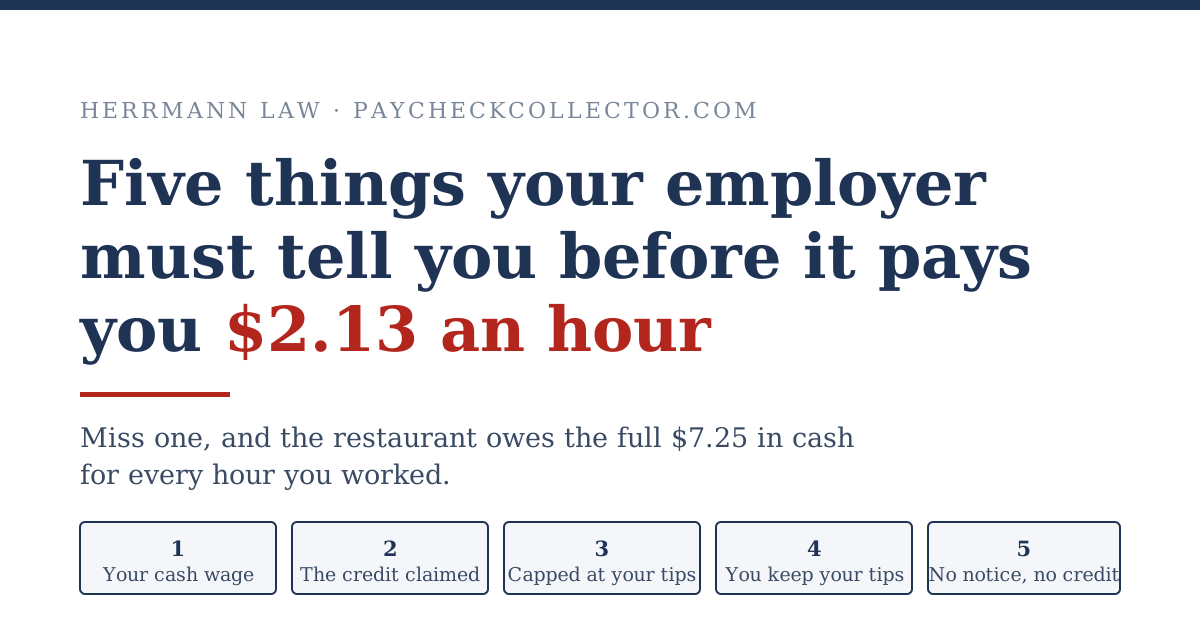
The Fair Labor Standards Act lets a restaurant pay you as little as $2.13 an hour. The other $5.12 of the $7.25 federal minimum wage is called the “tip credit”: the employer gets to count your tips toward its own minimum wage bill. The Department of Labor publishes those exact figures: a $2.13 minimum cash wage, a maximum tip credit of $5.12.
That deal comes with conditions, and they are written into the statute. Under 29 U.S.C. § 203(m)(2)(A), an employer taking the tip credit must let you keep all your tips, with one exception: it may require “pooling of tips among employees who customarily and regularly receive tips.”
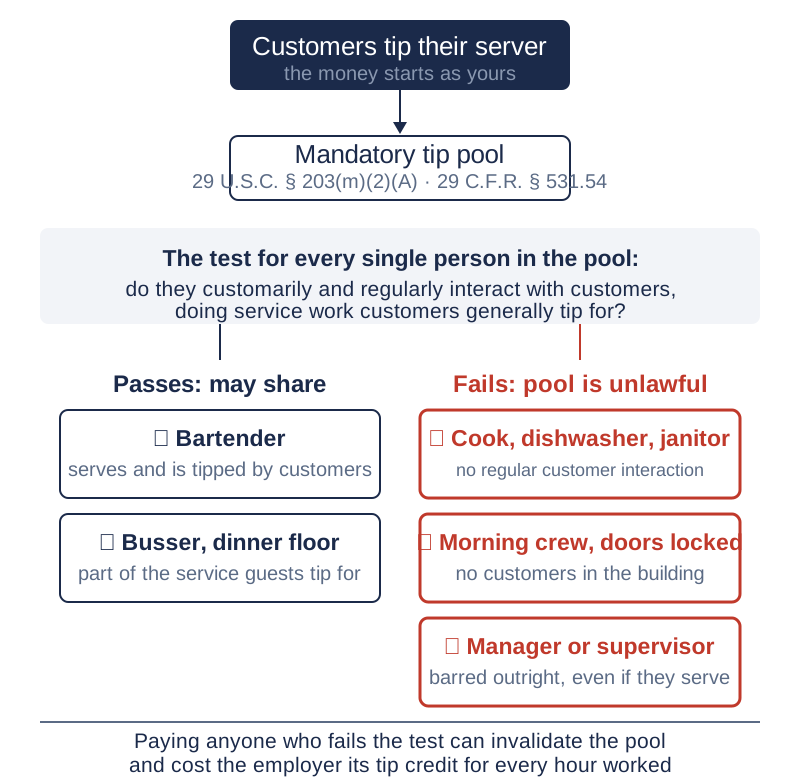 Who counts? The statute defines a “tipped employee” as someone “engaged in an occupation in which he customarily and regularly receives more than $30 a month in tips.” 29 U.S.C. § 203(t). The regulation says the same thing about pools: a mandatory tip pool must be “limited to employees who customarily and regularly receive tips.” 29 C.F.R. § 531.54. And the statute adds a flat prohibition: an employer “may not keep tips received by its employees for any purposes, including allowing managers or supervisors to keep any portion of employees’ tips.” 29 U.S.C. § 203(m)(2)(B).
That test applies to every single person paid from the pool. To lawfully share your tips, an employee must, at minimum, customarily and regularly interact with your customers and perform customer service work of the kind customers generally tip for. Cooks, dishwashers, prep cooks, and janitors fail that test even when the restaurant is packed, and paying any one of them from the pool makes the pool unlawful. Managers and supervisors are barred outright, no matter what else they do.
Job titles do not decide any of this. Duties do. A busser who clears tables on a packed dinner floor is part of the service customers are tipping for. A person with the same job title working alone in a locked building, or behind a kitchen door all night, is not. For the full eligibility rules, see our servers’ guide to tip pools and tip-outs.
No customers means no tips, and the law follows the customers
The question courts ask about every pool participant is the same: does this employee customarily and regularly interact with customers and perform service work that customarily produces tips?
Working while the restaurant is closed is simply the clearest way to fail that test. For employees who work before the doors open, the answer is close to automatic. In a February 2026 decision involving Perry’s Steakhouse’s Colorado restaurants, a federal court held that employees who work morning shifts while the restaurant is closed to guests cannot have more than minimal customer interaction, so they are not “customarily and regularly tipped” and cannot lawfully be paid from a server tip pool. A federal court in Texas reached the same conclusion after trial in a companion case in November 2025: the morning-shift bussers, hosts, and runners who shared the servers’ tip pool were not eligible to be in it.
The consequences run in one direction and they are severe for the employer. An invalid tip pool is not a bookkeeping error. It breaks the employer’s side of the tip-credit deal, which means the employer loses the tip credit for every hour you worked, owes you the difference back to the full minimum wage, and owes you the tips that went to ineligible people. Federal law then doubles the award: an employer who violates the minimum wage provisions is liable for the unpaid wages “and in an additional equal amount as liquidated damages.” 29 U.S.C. § 216(b).
The same section makes the employer pay your attorney’s fees and costs.
The math: what a 4.5% tip-out really costs you
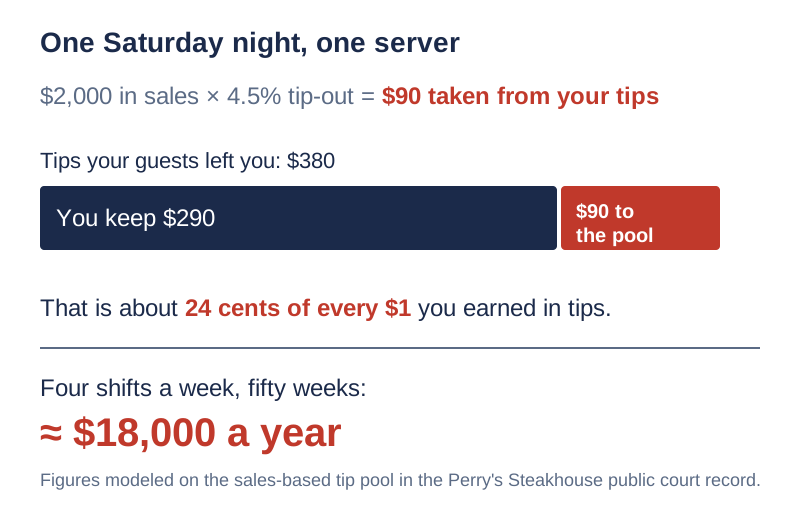
Perry’s Steakhouse required every server to pay 4.5% of total sales into the pool each shift. Not 4.5% of tips. Of sales.
Run a realistic Saturday night. You sell $2,000 in food and drinks. Your guests tip you about $380. The tip-out is 4.5% of the $2,000, so $90 comes off the top. That is roughly 24 cents of every dollar you earned in tips, gone in one line on the checkout screen.
Now stretch it across a year. Four shifts a week at that pace is $360 a week, about $18,000 a year, paid out of one server’s tips. Multiply that across every server, every shift, at every location, and you understand how the judgment reached eight figures.
What happened at Perry’s Steakhouse
Everything below comes from the public court record.
After a November 2025 trial ruling, on March 24, 2026, a federal judge entered a final judgment exceeding $21.2 million against Perry’s Restaurants Ltd. and its owner, personally, for 707 servers. The award included roughly $3.44 million in unpaid minimum wages, another $3.44 million in liquidated damages on those wages, about $7.07 million in misappropriated tips, another $7.07 million in liquidated damages on the tips, and employer payroll taxes.
Two findings deserve your attention. First, the court found the violations willful: Perry’s had faced prior Department of Labor investigations and years of wage litigation, and kept the tip pool anyway. Willfulness matters because it extends the recovery period from two years to three. 29 U.S.C. § 255(a). Second, the owner was held personally liable. A corporate shell did not protect the individual who controlled the pay practices.
One more fact from the docket: a new lawsuit was filed in January 2026 alleging that the same practices continued after 2023. A judgment did not end this. Servers working under a sales-based tip-out right now may be owed money right now.
What you can do tonight
You do not need to know the law to protect your claim. You need records.
Write down or photograph your daily sales totals and the tip-out taken from you each shift. Most POS checkout screens show both numbers. Save your schedules, and note who was working before the restaurant opened and what they did. Keep every pay stub. None of this is confidential business information; it is your own pay.
Then look at the clock. The recovery period runs two years back from the day a claim is filed, three if the violation was willful, and it keeps sliding forward every day you wait. 29 U.S.C. § 255(a). A tip pool that has been taking $90 a shift from you for years is losing you money twice: once at checkout, and again as each older shift slips outside the window. Our breakdown of what servers can recover shows how those numbers add up.
If your restaurant’s tip pool pays anyone who does not customarily serve customers (kitchen staff, prep crews, before-open workers), or pays a manager or supervisor anything at all, the pool is worth a hard look by a lawyer who handles these cases.
About Herrmann Law: We represent restaurant workers nationwide in unpaid wage, overtime, and tip theft cases. If your restaurant’s tip pool includes before-open, back-of-house, or management participants, contact us by submitting your information on our website or by calling or texting our office at 817-479-9229. Consultations are free, and we handle these cases on contingency: you pay nothing unless we recover for you.
Related reading: How restaurants abuse the tip credit · Side work rules for tipped employees
This article is general information, not legal advice, and reading it does not create an attorney-client relationship.
What to do if something feels off
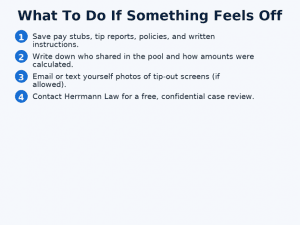
- Keep any Records you can. Keep copies of your pay stubs, POS reports, tip-out reports/breakdowns, employee policies/handbook, and any other documents your employer has given you or made available to you.
- Act quickly. Unlawful pools can mean recovering misdirected tips and back wages (often doubled), plus attorneys’ fees.
- Seek Legal Advice. Contact Herrmann Law to speak with an attorney for advice and guidance unique to your specific situation. We have represented thousands of restaurant workers across the United States. We offer free consultations and contingency fee agreements.
About Herrmann Law: We represent restaurant workers nationwide in unpaid wage, overtime, and tip theft cases. Questions about your situation? Contact us by submitting your information on our website or by calling or texting our office at 817-479-9229
You can also learn more by visiting our Legal Center for Restaurant Workers.
 Learn more about tipping laws and your rights
- Illegal Tip Pooling (Guide)
- Tip Pooling vs Tip Credit: What’s the Difference?
- Understanding Tip Credit Abuse
- Side Work Laws for Restaurant Employees
- Legal Center for Restaurant Workers
- Contact Herrmann Law
Disclaimer: The information on our website is provided for general informational purposes only, and is not legal advice. Laws, including wage-and-hour laws, vary by state and change over time. The facts specific to your situation and the laws in your state may lead to different outcomes. Do not act on this information without consulting a licensed attorney. For guidance on your specific situation, consult an attorney. No attorney-client relationship is created with Herrmann Law, PLLC and none of our attorneys represent you until Herrmann Law, PLLC has executed a written agreement, agreeing to represent you.